|
Yardage Chart 808-429-1099 cell 808-422-4321 office |
 |
|
| Contents | How to measure curtains | |
Use this chart for estimate purposes only. Please rely on a professional seamstress for your true yardage requirements. They will need to know the pattern repeat and width of the fabric. That information is located on the "BIG Picture" pages. email us if you have further questions. Mahalo!
Measuring Up for Curtains
Measuring up for your window treatments will be the first and most important
step you'll make when considering new curtains. Get the measurements wrong and
no matter how well your curtains are sewn your desired effect will not be
achieved. For curtains outside the recess, the track or pole needs to be wider
than the window frame [about 4" - 6" (10
cms
-15 cms)]
to allow for stacking the opened curtains. It should be fixed about 4" (10
cms)
above the top of the window frame and should be horizontal. It is advisable to
make a drawing plan of each window and transfer all the measurements onto it for
future reference. Never presume that 2 windows are exactly the same size even if
they look identical.
Take all the measurements in either inches or
centimetres.
DO NOT MIX THE TWO.
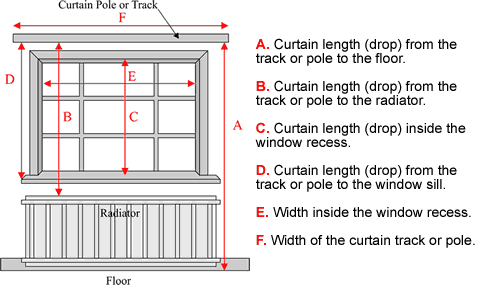
Use this diagram to configure your curtain measurements
 |
Measuring Curtain Width. Outside the Window Recess
- Measure the width of the track or
pole (F) adding any extra for center overlapping, normally about 6ins (15
cms).
- Multiply the track width by 1.5, 2
or 2.5 depending on the heading to be used.
- Divide that by the width of the fabric, normally 44" or 54" (122 cms or 137 cms), and round up to the next whole number to give the number of widths required. If an odd number results then one width can be cut in half and added to the outside edge of each curtain.
Measuring Curtain Width. Inside the Window Recess
- Measure the width of the window
recess (E) and multiply by 1.5, 2 or 2.5 depending on the heading to be used.
- Divide that by the width of the fabric, normally 48" or 54" (122 cms or 137 cms), and round up to the next whole number to give the number of widths required. If an odd number results then one width can be cut in half and added to the outside edge of each curtain.
Measuring Curtain Length. Outside the Window Recess
- For a pole, measure from the
bottom of the ring to wherever you wish the curtains to fall (A, B or D).
- For a track, measure from the top
of the track to wherever you wish the curtain to fall (A, B or D).
- For tab top curtains, measure from
the top of the pole to the required finished length (A, B or D). Deduct the
length of the tabs (approx. 3" [7.5
cms])
as the top of the curtain must come above the top of window frame. (This may
mean moving the pole.)
- To this measurement add 8" (20
cms)
to the finished length (2" (5
cms) for the top seam allowance
and 6" (15 cms)
for the bottom hem) for lined and unlined curtains with attached heading tape
or tab tops.
- For lined and unlined curtains
with cased headings add 10" (25
cms)
to the finished length (4" (10
cms) for the top seam allowance
and 6" (15 cms)
for the bottom hem).
- Short curtains should finish 0.5"
(12 mm) above the sill or radiator and full length curtains should fall within
1" (2.5 cms)
of the floor.
- If patterned material is to be
used then each length has to be a full pattern repeat, for example:- With a
pattern repeat of 25" and a curtain finished length of 54" you will need 75"
for each drop. i.e. 54" + 8" for hems = 62" rounded up to the next multiple of
25" (your pattern repeat). Multiply this amount by the number of widths
required and hey presto you have the length of fabric required.
- To calculate the amount of lining required (if used) multiply (the finished length plus hem allowance) by the number of widths required. Hem allowance is usually 6� (15 cms), 2� (5 cms) for the top seam and 4� (15 cms) for the bottom hem. Ignore any adjustments for pattern matching.
Measuring Curtain Length. Inside the Window Recess
- Measure the length of the window
recess (C). Curtains should finish 0.5" (12 mm) above the window sill so they
fall correctly.
- To this measurement add 8" (20
cms)
to the finished length [2" (5
cms) for the top seam allowance
and 6" (15 cms)
for the bottom hem] for lined and unlined curtains with attached heading tape
or tab tops.
- For lined and unlined curtains
with cased headings, add 10" (25
cms)
to the finished length [4" (10
cms) for the top seam allowance
and 6" (15 cms)
for the bottom hem].
- If patterned material is to be
used then each length has to be a full pattern repeat, for example:- With a
pattern repeat of 25" and a curtain finished length of 54" you will need 75"
for each drop. i.e. 54" + 8" for hems = 62" rounded up to the next multiple of
25" (your pattern repeat). Multiply this amount by the number of widths
required and hey presto you have the length of fabric required.
- For curtains with heading tape or
tab tops, calculate the amount of lining required (if used) by multiplying
(finished length + hem allowance) by the number of widths required. Hem
allowance is usually 6" (15 cms)
[2" (5 cms)
for the top seam allowance and 4" (10
cms)
for the bottom hem]. Ignore any adjustments for pattern matching.
- For curtains with cased headings, calculate the amount of lining required (if used) by multiplying (finished length + hem allowance) by the number of widths required. Hem allowance is usually 8" (20 cms) [4� (10 cms) for the top seam allowance and 4" (10 cms) for the bottom hem]. Ignore any adjustments for pattern matching


